
History
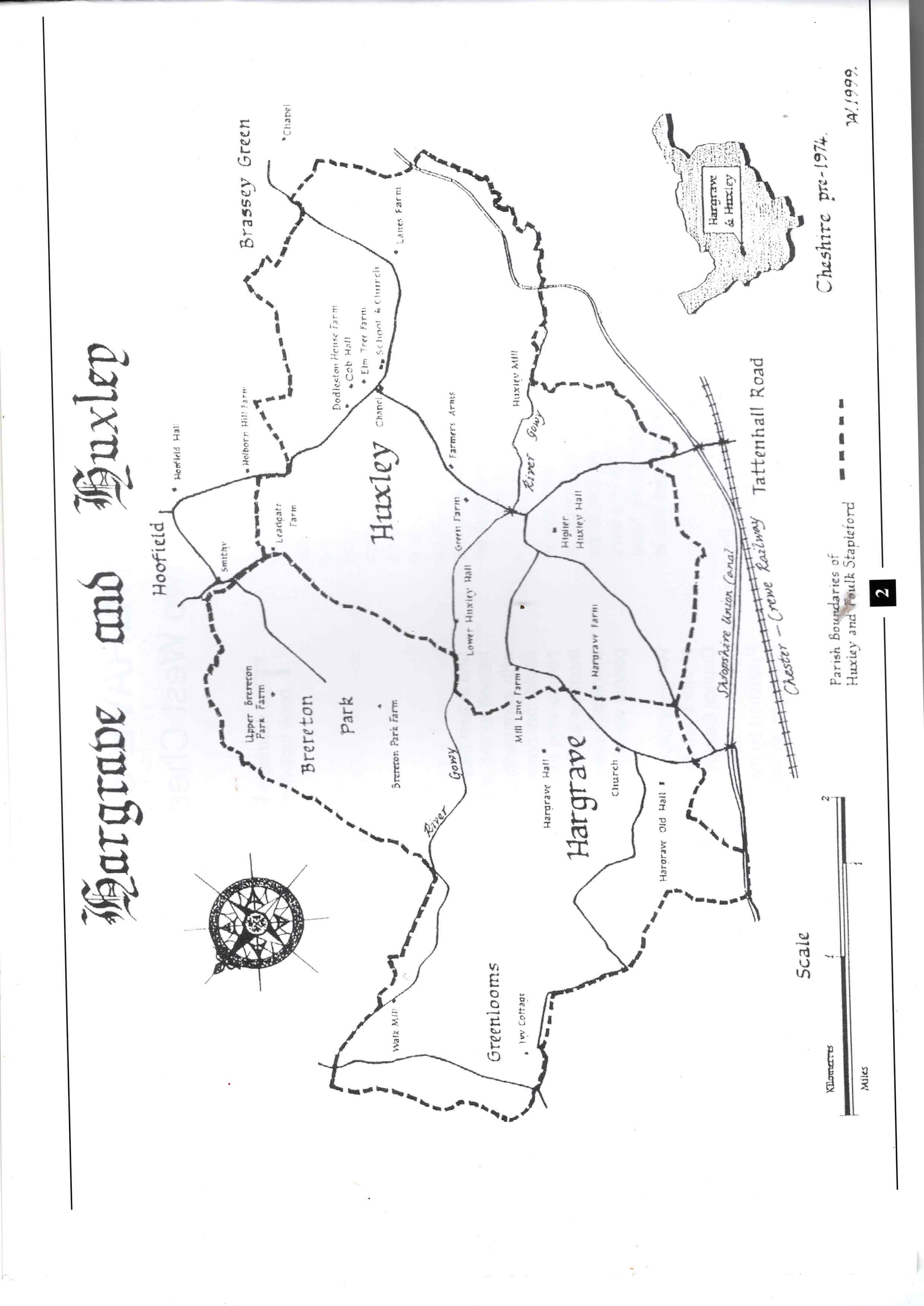
Hargrave and Huxley is located about 10 kilometres south east of Chester City and in the County of Cheshire, lying between the Chester to Whitchurch Road (A41) and the Chester to Nantwich Road (A51). It is skirted on the southern side by the Shropshire Union canal and the Chester to Crewe Railway. The River Gowy Flows through the area and is the main drainage channel for the district. Waterless Brook and Guy Lane Brook are tributaries. There have been several mills on the length of the Gowy since Domesday times.
History
Hargrave and Huxley is located about 10 kilometres south east of Chester City and in the County of Cheshire, lying between the Chester to Whitchurch Road (A41) and the Chester to Nantwich Road (A51). It is skirted on the southern side by the Shropshire Union canal and the Chester to Crewe Railway. The River Gowy Flows through the area and is the main drainage channel for the district. Waterless Brook and Guy Lane Brook are tributaries. There have been several mills on the length of the Gowy since Domesday times.
The district is a rural area with, historically, farming and related industries being the main occupation and milk and cheese being the chief end products.
Village Life in the 20th century centred around a number of institutions, particularly the churches and chapels, the schools, the few diminishing shops and post offices, the two village halls and one public house. Organisations, particularly the Womens Institute, the Sunday schools and more recently the Bowling Club, the Historical Group and others associated with Huxley School and the churches, have provided centres of interest and activity.
The Church of St Peter, Hargrave was founded in 1627 by Sir Thomas Moulson, former resident of Hargrave and later Lord Mayor of London as a church and school. The school was formally closed in 1954 and the pupils transferred to Huxley. The church will celebrate 400 years from its founding in 2027
Over the years there have been several religious houses in the district. The church dedicated to St Andrew was opened in Huxley in 1888. The Primitive Methodist Jubilee Chapel, built in 1960 at the T-junction, was repaired and extended in the 1990s. The former New Connexion Chapel was built in 1942.
Hargrave School was erected in 1833 having previously been located in one half of the church. It was extended in 1838.
Huxley C. of E. School was built on land given by R. Wilbraham to the Lord Bishop of Chester in 1851. In 1988-90 Huxley School was threated with closure by Cheshire County Council’s education committee because of the relatively low numbers of pupils. An action committed of parents, governors and friends was set up and fought the proposal with petitions, lobbying County Hall and by travelling to London to confront the Education Minister. On Tuesday, 20th February 1990 the Education Secretary announced that the school would not be closed. More recently in 2020 the school again was faced with potential closure due to low attendance rates, but following a public consultation and great effort from an intensive team of highly motivated members of the community a plan was put in place to offer flexi-schooling to students across the region. Following being able to demonstrate that the school had educational and financial sustainability the process of closure was terminated.
Farming in the area was the main source of employment and industry, farms include, but not limited to; Green Farm Huxley, Pool Bank Farm, Mill Lane Farm, Elm Tree Farm, Holburn Hill Farm, Leadgate Farm, Old Hall Farm, Hargrave, Church Farm.
Historically, there was also a local shop that was part of Acorn Cottage in Hargrave, a shop/post office ‘The Beeches’ and more specialised services provided in the area such as a butchers, garage providing petrol and repair services.
There had been mills in Hargrave and Huxley before Domesday but all have been demolished or adapted:- Walk Mill, off Guy Lane, Mill Cottage adjacent to Lower Huxley Hall and Huxley Mill which is now a farm dwelling